Brain injury / Living with brain injury
Lifting and moving
This page describes techniques for helping a person with physical disabilities to walk, sit, stand and move.
There are correct techniques for lifting and moving a person with disabilities.
By using the right technique, you can avoid damaging your own back and causing great discomfort – and possibly permanent harm – to your family member. Each person has different needs and disabilities, so before attempting any lifting or moving it is essential that you talk to your occupational therapist or physiotherapist first about the best ways to lift and move your family member. They can also give advice on aids and useful equipment. The information here is a general guide only.
- Make sure the things you may need – walking stick, frame – are close at hand.
- Let your arms and legs take the strain, not your back.
- Stand close to the person so that you can use your body to support them. Have your knees slightly bent, feet slightly apart and back straight.
- Just before you lift, tuck your chin into your chest to stabilise your spine.
- Try to coordinate your actions with the person you are helping. Counting may help – “One, two, three, up!”
- Lift by straightening knees and hips. Use whatever movement the person has to help you.
- Support the person using the palm of your hand so that your fingers do not dig into them. Support them gently under the elbow.
If using only one hand, put the other on a firm surface, or your knee, for extra support.
Allow the person to lean on you as they need to. Don't push up on them.
Lifting don’ts
Never pull on the person’s weak or paralysed arm or under the shoulder. This can seriously damage a weak shoulder or tear a ligament, causing considerable pain. It can also be very slow to heal.
This guide is also relevant to helping someone onto the toilet.
Choosing chairs
Avoid low, deep chairs. Choose a chair that is relatively high that has arm rests.You could raise the height of a chair on wooden blocks or a platform. Make sure the chair is stable. Special frames and seats are available to raise the height of a toilet.
Have aids ready
To help someone stand from a chair, have their stick or walking frame ready.
Think first
If the person has difficulty organising tasks or remembering, you may need to go over this routine many times, step by step. Encourage them to think the moves through before they start.
Get your family member to:
- Move to the edge of the chair.
- Ensure their feet are firmly on the ground, about 25 cm apart, well under the body, and that their hands are placed on the arm rests or on the sides of the chair seat.
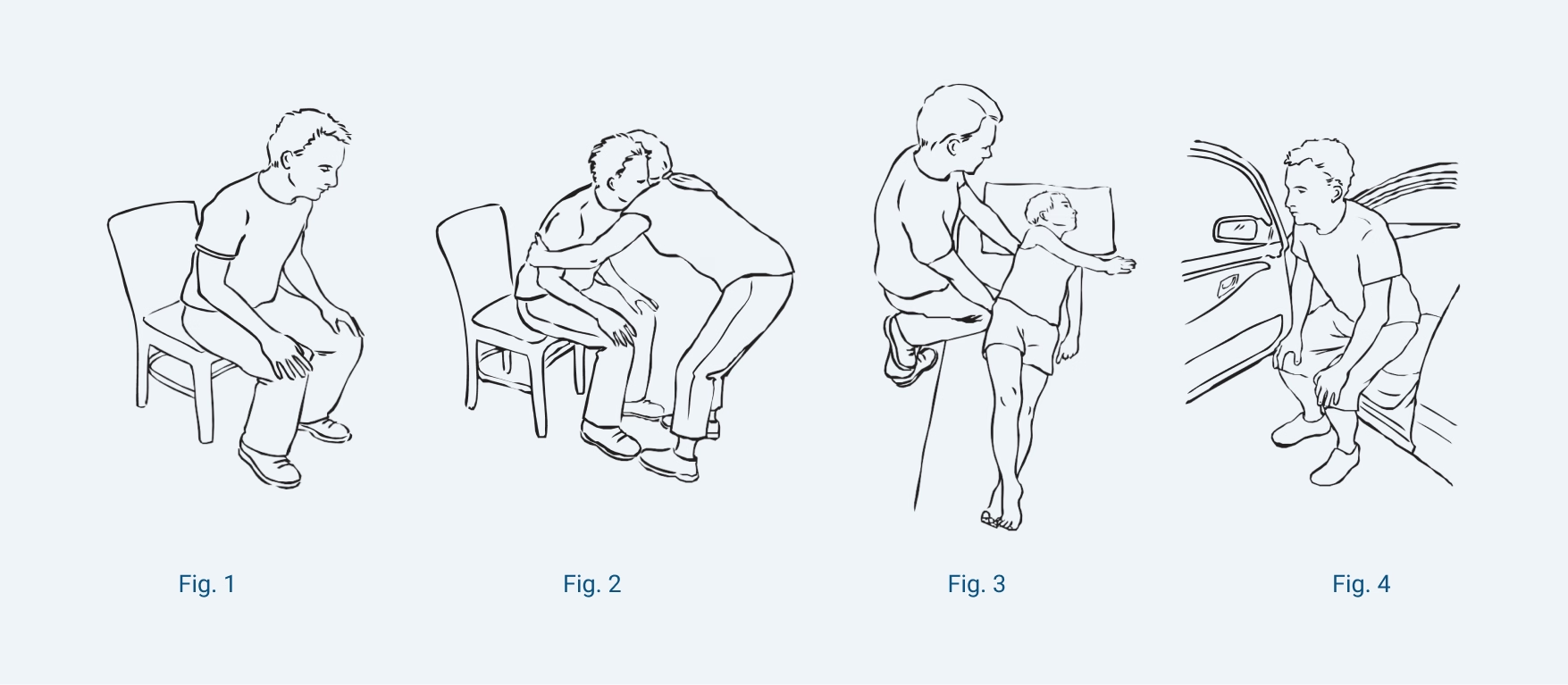
- Get them to lean well forward from their hips – “nose over toes” – and to press down on their feet, and forward and up on their arms. (See Fig. 1)
- Straighten the knees.
- If the person is moving from wheel chair to toilet or to another chair, they will need to turn, then sit again. Stepping around, using small steps on the spot is safer than swivelling.
- Before the person sits down, get them to stop in front of the chair and feel for the chair arms, placing one hand on each, before lowering themselves in a controlled way, bending slowly from the hips and knees.
The carer must:
- Use the lifting technique outlined earlier.
- Help the person by supporting them under the forearm, held close to their trunk. (See Fig. 2)
- Use your own foot to stop the person's foot from sliding forward as they stand.
- Make sure the person is standing as straight as possible and is balanced before they take any steps.
- It is usually easier for them to begin moving towards their stronger side, putting their strongest foot forward.
You could also use a Mayfield belt, a special belt available for lifting and moving people. Ask your physiotherapist or the Independent Living Centre.
Ask the person to lean forward then shift their buttocks backward. If the person needs help to slide the bottom backwards, hold underneath their buttocks or use a Mayfield belt.
It is generally easiest to help the person to roll onto their better side first, then they can use their arm/s to push up into a sitting position. Then they, or the carer, can move their legs over the edge of the bed.
A firm mattress and satin sheets can help your family member to turn in bed.
- Stand facing the direction they want to turn (let's say, the right side).
- Get them to turn their head to the right, stretch their left arm across their body towards the right edge of the bed, and cross the left leg over the right leg.
- Put one knee on the bed behind the person's back. Keep your other leg, knee slightly bent, firmly on the floor.
- Put one hand under the person’s right shoulder and the other under their right hip. (See Fig. 3)
- Leaning forwards, but keeping your back straight, turn the person onto their right side, straightening the leg you are standing on to help you lift.
Practise walking with your family member under a therapist's supervision before trying it alone. A Mayfield belt can be used to support the person – ask your therapist.
- A walking stick should always be held in the better hand.
- The person should move the walking stick or frame first, then the weaker leg, then the stronger leg.
- The helper should stand on the weaker side and should never pull on a weak arm. Support them gently under the elbow with the palm of your hand.
- Keep a watch on your family member's balance and fatigue levels.
Reduce the risk of falls by getting rid of loose rugs, turned up carpets, and loose-fitting slippers or shoes.
After a fall, make sure your family member is not hurting. Give them time to calm down and collect themselves before you start helping them to move.
- They must turn onto their side.
- Then get onto their hands and knees. Assist them if necessary.
- Crawl to a heavy piece of furniture (table, bench etc).
- Place their good hand or both hands on the table/bench.
- Bring their better knee up and place the foot firmly on the floor.
- Push up through the hand and straighten the knee to get into standing position.
If your family member is unable to get themselves up off the floor and you can't move them, make them comfortable by placing a pillow under their head and covering them with a blanket. Then contact someone for help – a neighbour, a relative or an ambulance if necessary.
Check with your physiotherapist for the method that best suits your family member. Some people find it easier to use a rail and step up with the better leg, then down with the weaker leg (or vice versa). Get the person to lean forward after stepping with the first leg. Some people prefer to go sideways.
- Place the wheelchair beside the car next to the front seat. Have the front seat moved well back.
- Make sure the chair brakes are on and move the footplates out.
- If the person is using a sling, Mayfield belt or walking aid, make sure that they are in position.
- Help the person to stand up as noted earlier.
- Support the person as best you can to step around to the car seat.
- The person should feel the seat with the back of their legs, then bend forward and gently sit down, without using the car door for support. (See Fig. 4)
- Lift their legs into the car, one at a time.
- To get out of the car, reverse this process.
Speak to the Independent Living Centre about gadgets that can assist getting someone in and out of vehicles.
If you don't already have a physiotherapist or occupational therapist, you can locate one through your doctor, hospital, community health centre or your condition-specific support organisation.